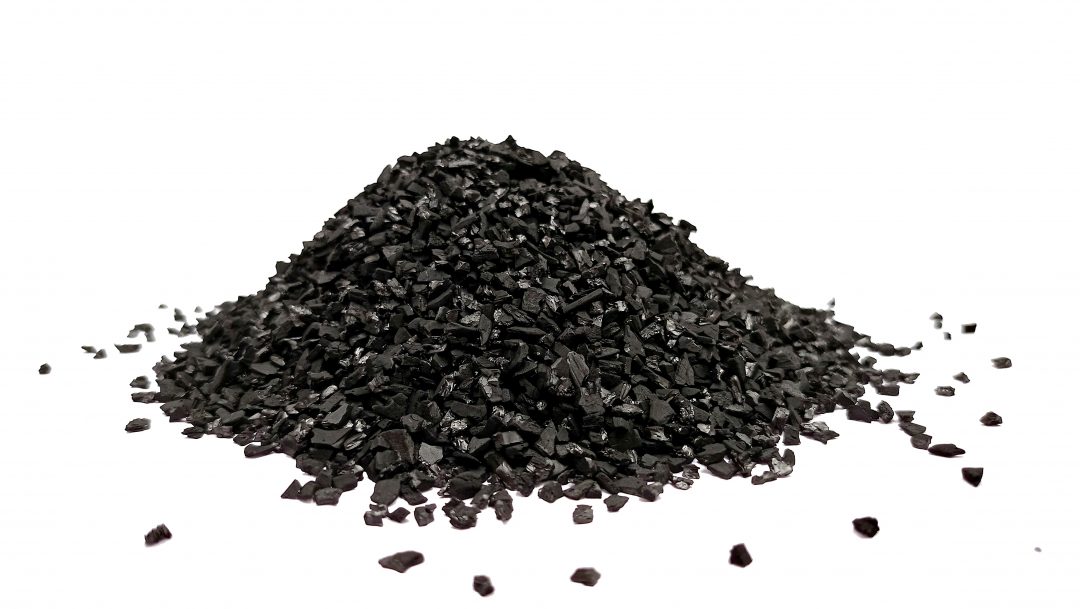
Activated carbon is one of the most common technologies used in household water filters. It is effective for many taste, odor, chlorine, and organic-contaminant problems, but it is often misunderstood.
Activated carbon does not remove everything equally.
Its performance depends on the contaminant, the carbon type, pore structure, contact time, flow rate, water chemistry, and the presence of competing substances. This is why two filters using “activated carbon” can behave very differently in real household use.
Why Adsorption Matters
Activated carbon works mainly through adsorption. This means dissolved substances attach to the surface and internal pores of the carbon instead of passing freely through the filter. NSF describes adsorption as a process where dissolved or suspended matter adheres to the surface or pores of an adsorbent medium, with carbon filters as a typical example.
The problem is capacity.
Carbon has a limited number of available adsorption sites. Once these sites are occupied, removal performance decreases and contaminants can pass through the filter. This is known as breakthrough.
Key limitation:
Activated carbon capacity ≠ universal contaminant removal
What Breakthrough Means
Breakthrough occurs when a contaminant is no longer sufficiently retained by the filter and appears in the treated water.
This does not always happen suddenly for all substances at the same time. One contaminant may break through early while another is still being removed effectively. Purdue Extension notes that activated carbon filters have a limited lifetime, that breakthrough occurs when pollutants emerge in treated water, and that no alarm automatically warns the user when breakthrough happens.
That is the hidden risk.
A filter can still improve taste while already losing performance against a specific contaminant.
Why Some Contaminants Break Through Earlier
Breakthrough depends on how strongly a contaminant competes for adsorption sites.
Substances that bind weakly, move quickly through the pores, or are present alongside stronger competitors can break through earlier. Water is never chemically empty. Natural organic matter, chlorine byproducts, pesticides, solvents, PFAS, and other trace compounds may compete for the same adsorption capacity.
The Irish EPA’s water treatment guidance states that other adsorbates in water can affect activated carbon capacity for a specific compound, even when those competing compounds are weaker adsorbers.
Key limitation:
A filter is treating the whole water matrix, not one contaminant in isolation
Adsorption Competition in Real Water
Laboratory tests often focus on selected contaminants under controlled conditions. Real household water is more complex.
Natural organic matter can occupy pores before target contaminants reach them. Larger organic molecules can block access to smaller internal pores. Strongly adsorbing compounds can displace weaker compounds. High contaminant concentration, high flow rate, and short contact time can also accelerate breakthrough.
This is why cartridge lifetime cannot be judged only by calendar time.
A household using more water, higher flow rates, or water with more competing organic matter may exhaust the same filter faster than a household with lower demand and cleaner incoming water.
Carbon Type and Pore Structure
“Activated carbon” is not a single material.
Carbon can be made from sources such as coconut shell, coal, wood, peat, or other carbon-rich materials. Different carbons have different pore structures and adsorption behavior. The Irish EPA notes that activated carbon media selection depends on the target compounds and water quality, and that pore size and structure should match the substances intended for removal.
This matters because different contaminants need different pore environments.
Small organic compounds may require micropores. Larger organic molecules may need mesopores or macropores. Some compounds are affected by charge, hydrophobicity, and molecular size. For PFAS, research has shown that breakthrough behavior varies with PFAS hydrophobicity and carbon characteristics.
Why Standard Replacement Intervals Can Fail
Many filters are replaced after a fixed number of liters or months.
That is useful, but incomplete.
Standard replacement intervals are estimates. They may not reflect actual contaminant levels, water use, flow rate, or competing substances in the local water. Purdue Extension states that cartridge longevity predictions are crude unless they account for the specific water source, pollutant concentration, and water usage.
Key limitation:
Time-based replacement ≠ verified contaminant control
Without contaminant-specific testing or certified performance data, users may assume the filter is still protecting them when only taste improvement remains.
Impact on Household Drinking Water
Health Protection:
Activated carbon can reduce selected organic chemicals, chlorine, chloramines, some disinfection byproducts, and taste- or odor-causing compounds, depending on the filter design and certification.
False Security:
A filter may still make water taste better while no longer reducing the contaminant that matters most.
Performance Variation:
Two households using the same cartridge can experience different breakthrough timing because water chemistry and usage patterns differ.
Contaminant-Specific Risk:
A filter certified for chlorine taste reduction is not automatically certified for PFAS, pesticides, VOCs, lead, or other health-related contaminants. NSF distinguishes between aesthetic reduction claims under NSF/ANSI 42 and health-related contaminant reduction claims under NSF/ANSI 53.
Control and Prevention Strategies
Activated carbon filters should be selected and maintained based on the actual water-quality problem, not on generic “carbon filter” claims. Users should check whether the system is certified for the specific contaminant of concern, follow replacement intervals conservatively, avoid excessive flow rates, and replace cartridges earlier when water use is high or water quality is uncertain. For high-risk contaminants such as PFAS, VOCs, pesticides, or lead, taste improvement is not enough. The filter must have contaminant-specific performance data. In technical systems, carbon selection should consider pore structure, empty bed contact time, target compounds, and competing organic matter. In households, the practical rule is simple: do not treat all activated carbon filters as equivalent.
Conclusion
Activated carbon is useful, but not universal.
Its performance is controlled by adsorption capacity, contaminant chemistry, pore structure, contact time, water use, and competition from other substances. Some contaminants break through earlier because they bind less strongly, move faster through the media, or compete poorly against other compounds in the water.
The main risk is false confidence.
A filter can still improve taste while already losing protection against a specific contaminant. Effective use requires contaminant-specific certification, realistic replacement behavior, and an understanding that breakthrough is not always visible.
Ignoring adsorption competition means assuming that one filter removes everything equally. That assumption is technically wrong.
For more information, visit klar2o.de.